Home care, on the wrist and in the room
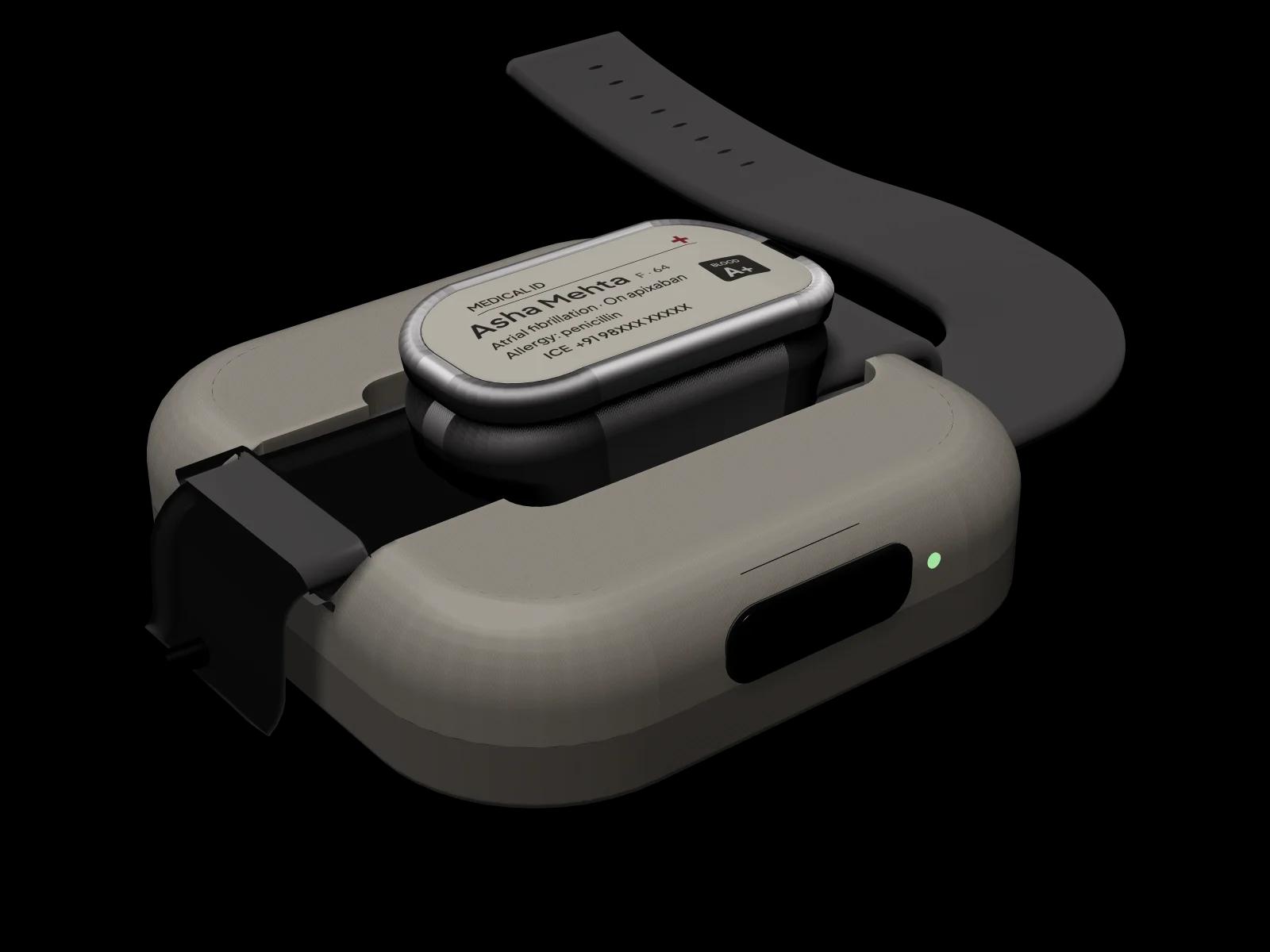
SamaBeat is a monitoring system in clinical validation for people who are cared for at home. The band is worn on the wrist through the day. At night it sits on the Home Dock, which charges it and senses the room without touching the patient.
It is not cleared or approved by any regulator yet, and it does not call emergency services.
How the day works
The band has to charge anyway. The dock makes that moment useful.
By day, the band on the wrist
A screenless sensing core with multi-wavelength optics, ECG and bioimpedance, the clip-on E Ink medical ID, and check-ins over 2G where there is no phone.
At night, the band on the dock
Set the band in the cradle. The dock charges and syncs it, reads which band it is so the night belongs to that person, and starts a sensing session. A small light shows sensing is on. The band itself does not sense while docked.
One patient timeline
Wrist readings from the day and room readings from the night land on one timeline for the clinician to review, with a confidence flag on each value.
What the dock senses
Two sensors, no camera, no microphone. Every output carries a confidence flag and the share of the night it was valid, so a reviewer knows how far to trust it.
Presence, movement and restlessness
Read from. Wi-Fi channel data heard from the home router. Listening to a router gives a coarser signal than a dedicated sender, so this is a presence and movement feature only.
Status. Being validated in a pilot: empty-room and nuisance tests first, then nights alongside a chest ECG strap and a finger oximeter.
Breathing rate
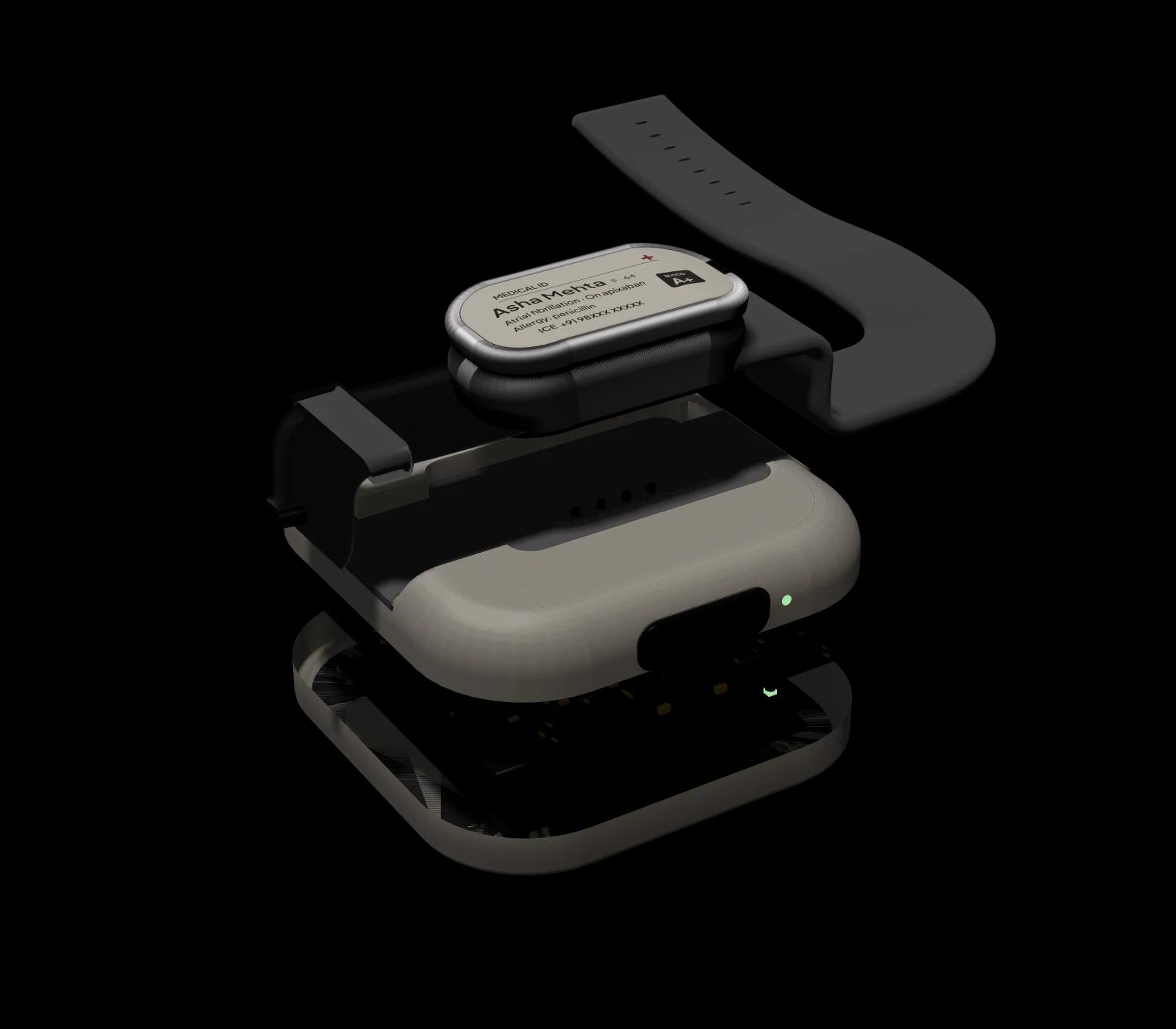
Read from. A 60 GHz radar behind the flat window on the room-facing side, which reads chest-wall motion without touching the sleeper.
Status. Being validated in a pilot against a chest ECG strap and a finger oximeter, with targets set in advance.
Overnight heart rate variability trend
Read from. The same radar, from the much smaller chest-wall motion of the heartbeat. The output is an overnight RMSSD trend with the percent of valid time.
Status. Validation planned. If radar HRV does not hold up, the fallback is a thin under-mattress strip cabled to the dock.
Inside the dock
One radio module, an external antenna along the back edge away from the charging contacts, the radar behind the front window, a USB-C power inlet and a physical privacy switch. The parts in the model are placeholders.
What it does not do
- No heart rate from Wi-Fi. Wi-Fi channel data is used for presence and movement only.
- No apnea diagnosis. Breathing and heart rate variability trends are for a clinician to review. They are not a diagnosis.
- No haemoglobin, dementia or cancer side-effect detection from the room signal. The room signal is presence, movement, breathing and a heart rate variability trend, nothing more.
- One sleeper per dock. Two people in one bed is a later research question.
- No emergency calls. The system does not call emergency services.
Haemoglobin and SpO₂ come from the band and the SamaClip optics. That work rests on our precursor multi-wavelength finger clip, which was tested in 182 adults (175 analysed) across Monk Skin Tone categories 4 to 10 against the NABL-accredited reference lab at Anubhav Life Care. Those results describe the finger clip only, not the band or the dock.
Who it helps
Respiratory and sleep care first
People on home oxygen or CPAP, and people whose breathing at night matters to the clinic. The dock gives the care team an overnight breathing and restlessness trend to review beside the wrist readings.
Then chronic and palliative care at home
People who are home for long stretches. The band by day, the dock at night, one timeline for the care team and the family.
Later phases
Dementia and cancer side-effect care are later phases. What the room signal could offer them is a research question we have not answered, not a feature.
Privacy
- No camera, no microphone. The dock has neither, by design.
- Only derived values leave the home. Presence, movement, breathing rate, the heart rate variability trend and their confidence flags. Raw channel and radar data stays on the dock, except on consented pilot nights with notice to everyone in the home.
- Consent for every person in the home. Guests and guardians included, under India's Digital Personal Data Protection Act.
- A physical privacy switch. On the back of the dock, with the small sensing-on light on the front so anyone in the room can see the state.
Evidence and next steps
Where each measure stands. Every number names who was studied, where, and against what.
| Measure | Reference | Who and where | Status |
|---|---|---|---|
| SpO₂ and haemoglobin optics (band, SamaClip) | NABL-accredited reference lab | 182 adults enrolled and 175 analysed in Barasat on the precursor multi-wavelength finger clip, Monk Skin Tone 4 to 10 | Study complete. Results describe the finger clip only. |
| Presence, movement and restlessness (dock) | Empty-room and nuisance tests: fan, air conditioner, curtain, pet, a person in the next room | 3 rooms, 7 nights each | Planned, before the volunteer nights |
| Breathing rate (dock) | Chest ECG strap or patch, and a finger oximeter | At least 15 volunteers, 2 to 3 nights each, all sleeping positions, in homes the model has not seen | Pilot in preparation. Targets set in advance. Median and 95th percentile error and percent valid time to be reported. |
| Overnight heart rate variability trend (dock) | Chest ECG strap or patch | The same volunteers and nights | Validation planned |
| Noise floor (dock) | Bench measurement | Charger on and off, band docked and undocked | Planned |
SamaHealth is an Indian company at the clinical trial and pilot validation stage. The dock is one prototype in development. Nothing on this page is a performance claim, and the system holds no clearance or approval in any country.
Clinicians and partners
If you run a home care, respiratory or sleep service and want to see the protocol, or to take part in the pilot, write to us.